Apto AI vs Traditional CRM Software: What's the Difference?
Customer Relationship Management (CRM) software has become an essential tool for businesses that want to manage leads, track customer interactions, and improve sales performance. For years, traditional CRM systems have helped organizations organize customer data and manage sales pipelines.
However, as businesses evolve, many teams discover that traditional CRM platforms often come with limitations. Fixed workflows, rigid structures, and manual processes can make it difficult to adapt the software to unique business requirements.
This is where Apto AI takes a different approach.
Instead of expecting businesses to adapt to the CRM, Apto AI is designed to adapt to the business. By combining AI-powered workflows, lead management, automation, task coordination, and communication tools into one platform, Apto AI provides a more flexible way to manage customer relationships and business operations.
In this article, we'll explore the key differences between Apto AI and traditional CRM software.
Understanding Traditional CRM Software
Traditional CRM software is primarily designed to store customer information, track sales activities, and manage pipelines.
Most CRM systems provide features such as:
Contact management
Sales pipelines
Lead tracking
Activity logging
Basic reporting
Task reminders
These features can help businesses organize customer data and maintain visibility into sales activities.
However, many traditional CRM platforms are built around predefined workflows and standardized processes. As a result, businesses often need to adjust their operations to fit the software rather than using a system that aligns with how they already work.
What Is Apto AI?
Apto AI is an adaptive AI CRM built to help businesses capture, qualify, route, nurture, and manage leads through intelligent automation and AI-powered workflows.
The platform combines:
Lead management
AI chat
Lead qualification
Lead routing
Task management
Workflow automation
Pipeline management
WhatsApp communication
into a single adaptive system.
The goal of Apto AI is simple:
Help businesses manage leads and customer interactions without forcing them into rigid processes.
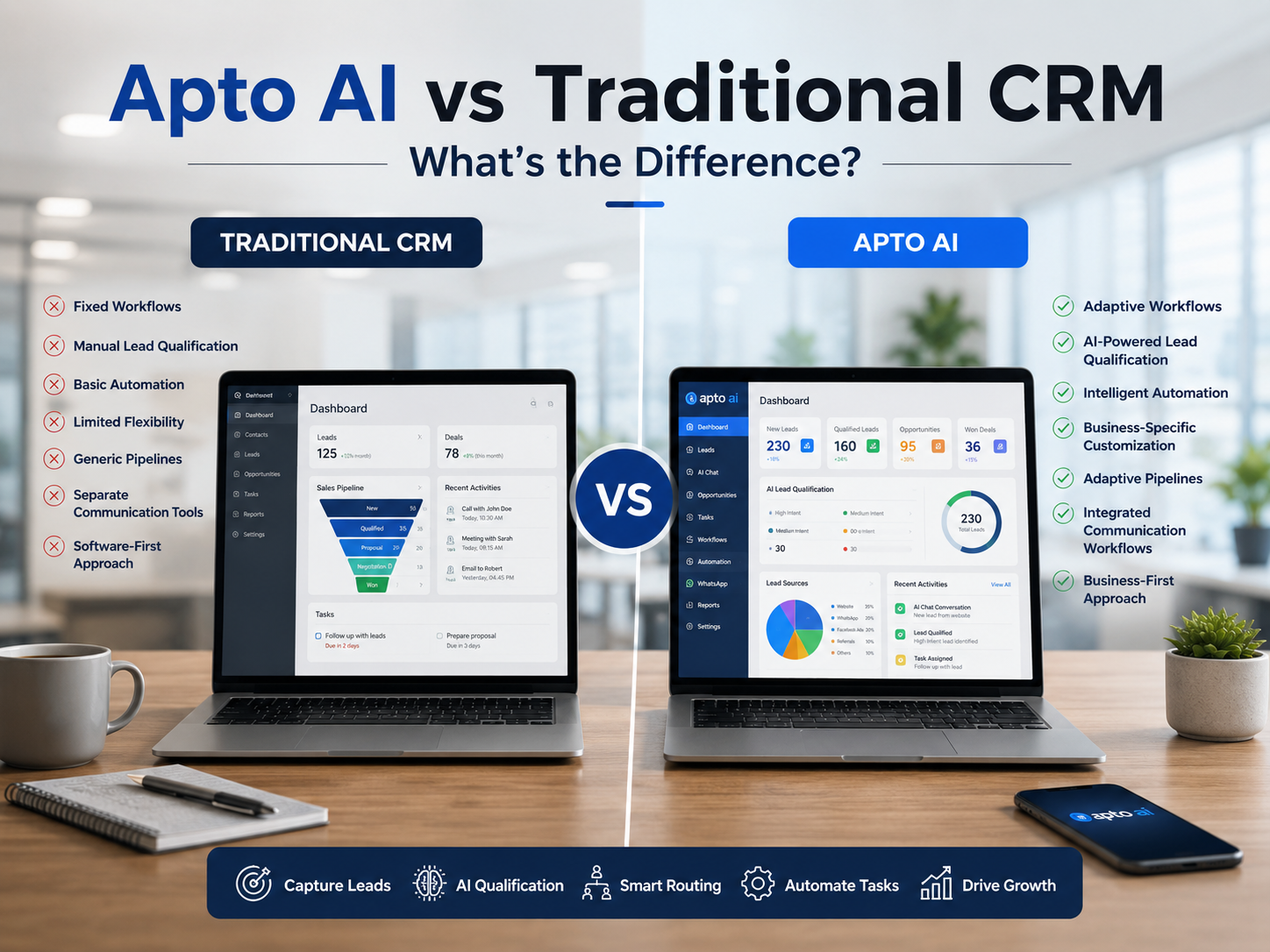
Apto AI vs Traditional CRM Software
The biggest difference between Apto AI and traditional CRM software is adaptability.
Traditional CRM systems often require businesses to follow predefined structures. Apto AI is designed to support existing business processes while helping teams automate and manage lead operations more efficiently.
Traditional CRM | Apto AI |
Fixed workflows | Adaptive workflows |
Manual lead qualification | AI-powered lead qualification |
Basic automation | Intelligent workflow automation |
Limited flexibility | Business-specific customization |
Generic pipelines | Adaptive pipelines |
Separate communication tools | Integrated communication workflows |
Software-first approach | Business-first approach |
Workflow Flexibility
One of the most common challenges businesses face with traditional CRM platforms is workflow rigidity.
Many systems require users to follow predefined stages, structures, and processes. If a business has unique requirements, teams often need to create workarounds or change the way they operate.
Apto AI takes a different approach.
The platform is designed to adapt to:
Existing sales processes
Team structures
Customer journeys
Communication methods
Lead management workflows
This flexibility allows businesses to maintain their preferred operating style while still benefiting from CRM technology.
Lead Qualification
Lead qualification is an important part of any sales process.
In traditional CRM systems, qualification often depends on manual reviews and user input. Teams may spend significant time identifying which opportunities deserve immediate attention.
Apto AI includes AI-powered lead qualification workflows that help businesses evaluate lead intent and prioritize opportunities more efficiently.
This allows teams to focus on high-value leads and improve response efficiency.
Automation Capabilities
Automation is available in many CRM systems, but the level of automation can vary significantly.
Traditional CRM platforms often provide basic automation such as reminders, notifications, or simple workflow triggers.
Apto AI is built around intelligent workflow automation.
Businesses can automate activities such as:
Lead routing
Follow-ups
Task assignments
Reminders
Lead updates
Customer communication workflows
By reducing repetitive work, teams can spend more time focusing on customer relationships and growth.
Communication Management
Modern businesses communicate through multiple channels.
Many traditional CRM systems require third-party tools or separate applications to manage communication effectively.
Apto AI includes communication-focused workflows, including WhatsApp-based communication management.
This helps businesses keep customer conversations connected to their lead management processes.
Managing Sales Pipelines
Sales pipelines are a core component of CRM software.
Traditional CRM platforms usually offer standard pipeline structures that businesses customize to a certain extent.
Apto AI supports adaptive pipeline management that aligns with the way businesses manage opportunities and customer journeys.
This provides visibility into sales activities while supporting different operational models.
Task Management and Accountability
Successful lead management requires consistent follow-up and team accountability.
While many CRM systems provide task functionality, managing tasks across multiple workflows can become challenging.
Apto AI combines task management with lead operations, helping teams:
Create tasks
Assign responsibilities
Track progress
Monitor activities
Improve accountability
This creates better visibility across lead-related activities.
Why Businesses Choose Apto AI
Businesses choose Apto AI because it offers more than traditional CRM functionality.
Key advantages include:
Faster lead response
Better follow-up consistency
Reduced manual effort
Smarter lead qualification
Improved pipeline visibility
Better team accountability
Workflow automation
CRM processes that adapt to business operations
Rather than focusing only on data management, Apto AI helps businesses manage lead operations more effectively.
Is Apto AI Replacing Traditional CRM Software?
Apto AI is not simply trying to replicate what traditional CRM platforms already do.
Instead, it builds on the core benefits of CRM software while introducing adaptability, automation, and AI-powered workflows.
For businesses that want greater flexibility and a CRM system aligned with their existing processes, Apto AI provides an alternative approach.
Conclusion
Traditional CRM software has helped businesses manage customer relationships for many years. However, many organizations now require greater flexibility, automation, and workflow adaptability.
Apto AI addresses these needs by combining CRM functionality with AI-powered lead qualification, workflow automation, lead routing, task management, communication workflows, and adaptive business processes.
For businesses looking for a CRM that works around their operations instead of requiring operational changes, Apto AI offers a more adaptable approach to lead management and customer engagement.